- PART 1: Antichrists revealed by our Jesus Christ – Linus the first antichrist (2Timothy 4:21)
- Part 2: Antichrists revealed by Jesus Christ – Idols Worshipping
- PART 3: Antichrists revealed by Jesus Christ – Deceptions of the antichrists
- PART 4: Antichrists revealed by our Lord Jesus Christ – How the Antichrist made dead people into sainthood
- PART 5: Antichrists revealed by Jesus Christ – Opposing spirits of the antichrists
- PART 6: The Antichrists revealed by Jesus Christ – False teachings of the antichrists
- PART 7: Antichrists revealed by Christ – Enmity of the antichrists towards Christ
- PART 8: Antichrist revealed by Jesus Christ – Falsehood and web of lies
- PART 9: Antichrists revealed by Jesus Christ – Mary mother of the Roman Catholic Church
- PART 10: Antichrists revealed by Jesus Christ – John Paul 11 and the Virgin Mary
- PART 11: Antichrists revealed by Jesus Christ – Wrong teachings of the antichrists
- PART 12: Antichrists revealed by Jesus Christ – The making of Images by the Antichrist
- PART 13: Antichrists revealed by Jesus Christ – Idolising images by the antichrists
- PART 14: Antichrists revealed by Christ – Feasts of the antichrists
- PART 15: Antichrists revealed by Jesus Christ- The false doctrine of the Papacy from the mouths of the Roman catholic churches worldwide
- PART 16: Antichrists Revealed by Jesus Christ – Disobedience of the antichrists against Christ
- PART 17: Antichrists revealed – Delibrate rebellion of the antichrist towards Christ
- PART 18: Antichrists Revealed by Christ – Making of Mary queen of heaven by the antichrists
- PART 19: Antichrists revealed by our Lord Jesus Christ Himself
- PART 20: Antichrists revealed by Jesus Christ – Making of images on God’s altars
- PART 21: Antichrists revealed by Christ – Fales doctrines of the antichrists
- PART 22: Antichrists revealed by Jesus Christ – False miracles of the Antichrists
- PART 23: Antichrists Revealed by Jesus Christ – The Secret Finances of the Vatican Economy
- PART 24 – Antichrists revealed by Jesus Christ – Going against Christ about images
- The queen ship of Mary -by the antichrists
- Vicarious Fiii Dei – The Number 666
- The relics of Mary’s veil – according to the antichrists
- The Antichrists or line of Popes dead or alive
- The Antichrist taught the Roman catholic churches the celebration of Ash Wednesday
- Biblical Truth: Jesus Christ “NOT” the founder of the Roman Catholic Church
| Marian apparitions recognized by the Vatican | ||||
| title | date(s) of apparition(s) | witness(es) | modern-day location | feast day |
| Our Lady of Guadalupe | December 9–12, 1531 | St. Juan Diego(primary), Juan Bernardino | Mexico City | December 12 |
| Our Lady of Leżajsk | 1578 | Thomas Michalek | Leżajsk, Poland | none |
| Our Lady of Šiluva | 1608–12 | Four shepherd children | Šiluva, Lithuania | September 8 |
| Our Lady of Laus (also known as Our Lady of Happy Meetings) | 1664–1718 | Benoîte Rencurel | Saint-Étienne-le-Laus, France | September 27 |
| Our Lady of the Miraculous Medal | July 18–November 27, 1830 | St. Catherine Labouré | Paris | November 27 |
| Our Lady of Zion | January 20, 1842 | Marie-Alphonse Ratisbonne | Rome | November 17 |
| Our Lady of La Salette | September 19, 1846 | Maximin Giraud, Melanie Calvat | La Salette, France | September 19 |
| Our Lady of Lourdes | February 11–July 16, 1858 | St. Bernadette Soubirous | Lourdes, France | February 11 |
| Our Lady, Help of Christians | January 13, 1866 | Magdalene Kade | Filipov, Czech Republic | January 13 |
| Our Lady of Hope | January 17, 1871 | Eugène Barbedette, Joseph Barbedette, Françoise Richer, Jeanne-Marie Lebossé | Pontmain, France | January 17 |
| Our Lady of Gietrzwałd | June 27–September 16, 1877 | Justyna Szafryńska, Barbara Samulowska | Gietrzwałd, Poland | September 8 |
| Our Lady of Knock | August 21, 1879 | Dominick Byrne, Sr., Dominick Byrne, Jr., Margaret Byrne, Jr., Margaret Byrne, Mary Byrne, Patrick Byrne, Judith Campbell, John Curry, John Durkan, Patrick Hill, Bridget Flatley, Mary McLoughlin, Catherine Murray, Bridget Trench, Patrick Walsh | Knock, Ireland | August 21 |
| Our Lady of Fátima(also known as Our Lady of the Rosary) | May 13–October 13, 1917 | Lucia dos Santos, St. Jacinta Marto, St. Francisco Marto | Fátima, Portugal | May 13 |
| Our Lady of Beauraing (also known as the Virgin with the Golden Heart) | November 29, 1932–January 3, 1933 | Fernande Voisin, Andrée Degeimbre, Gilberte Voisin, Albert Voisin, Gilberte Degeimbre | Beauraing, Belgium | August 22 |
| Our Lady of Banneux (also known as the Virgin of the Poor) | January 15–March 2, 1933 | Mariette Beco | Banneux, Belgium | May 31 |
| Our Lady of Kibeho (also known as Mother of the Word) | November 28, 1981–November 28, 1989 | Alphonsine Mumureke, Nathalie Mukamazimpaka, Marie Claire Mukangango | Kibeho, Rwanda | November 28 |
Many other alleged Marian apparitions have become well known. The table below lists a few other notable Marian apparitions and notes their current status.
| other notable Marian apparitions | |||
| title | date(s) of apparition(s) | modern-day location | status |
| Our Lady of Good Success | February 2, 1594–December 8, 1634 | Quito, Ecuador | Approved by local bishop |
| Our Lady of Good Help | October 9–17, 1859 | Champion, Wisconsin | Approved by local bishop |
| Our Lady of Sorrows of Chandavila | 1945 | La Codosera, Spain | Declared nihil obstat |
| Our Lady of All Nations | 1945–59 | Amstedam | Declared not supernatural |
| Our Lady of Light | 1968–71 | Cairo | Approved by the Cotic Orthodox Church |
| Our Lady of Akita | July 6–October 13, 1973 | Akita, Japan | Approved by local bishop |
| Our Lady of Medjugorje | 1981–present | Medjugorje, Bosnia and Herzegovina | Declared nihil obstat |
| Our Lady of the Rosary | 1983–present | San Nicolas, Argentina | Approved by local bishop |
| Bleeding Madonna of Trevignano Romano | 2016–present | Trevignano Romano, Italy | Declared not supernatural, devotion forbidden |
Philosophy & Religion
Religious Personages & Scholars | Saints & Pope
Also known as: Blessed Virgin Mary, St. Mary, The Madonna, the Virgin Mary
Mary (flourished beginning of the Christian era) was the mother of Jesus, venerated in the Christian church since the apostolic age, and has been a major subject in Western art, music, and literature. Biblical references to her are sparse, making it difficult to construct a detailed biography. The development of Marian doctrine can be traced through the titles given to her over time, including: guarantee of the Incarnation, virgin mother, second Eve, mother of God, ever virgin, immaculate, and assumed into heaven. She has multiple feast days in Christian traditions, several of which are holy days of obligation for Roman Catholics. Famous shrines and pilgrimage sites associated with her include Our Lady of Fatima, Our Lady of Lourdes, Our Lady of Guadalupe, Our Lady of Loreto, and Our Lady of Medjugorje.
Mary in Art
Virgin and Child: Also called the Poligny Virgin, this limestone sculpture with polychromy and gilding is attributed to Claus de Werve (c. 1420) and is held at the Metropolitan Museum of Art, New York City. Its name reflects its former location in the convent of the Poor Clares in Poligny, Burgundy, France.
Biblical Accounts and Humility
Mary is known for her humility and obedience to God’s message, making her an exemplar for Christians of all ages. From the details in the New Testament, Christian piety and theology have constructed a picture of Mary fulfilling the prophecy in the Magnificat (Luke 1:48): “Surely, from now on all generations will call me blessed.”
The first biblical mention of Mary is in the Annunciation, when she was living in Nazareth and betrothed to Joseph (Luke 1:26 ff.). Her last mention (Acts 1:14) places her among those devoted to prayer after Jesus’ ascension. Key Gospel incidents include:
-
The Annunciation
-
The Visitation with Elizabeth (Luke 1:39 ff.)
-
The birth of Jesus and presentation in the Temple (Luke 2:1 ff.)
-
The visit of the Magi and the flight to Egypt (Matthew 2:1 ff.)
-
The Passover visit to Jerusalem at age 12 (Luke 2:41 ff.)
-
The marriage at Cana (John 2:1 ff.)
-
Attempting to see Jesus during his teachings (Mark 3:31 ff.)
-
Her station at the cross, entrusted to the disciple John (John 19:26 ff.)
Even if these events are taken as literal, they do not form a fully integrated portrait of Mary. She plays a major role only in the Nativity and the Passion. At the Annunciation, she accepts the privilege of bearing Jesus, which introduces the Christmas story. At the cross, she witnesses the culmination of Jesus’ mission. In other incidents, she appears as a human figure, sometimes unsure of Jesus’ mission.
Christian Reflection and Interpretation
Since early Christianity, these scenes have inspired reflection and theological thought. Different Christian communions and theologians interpret Mary based on how far they consider the development of Marian doctrine to have legitimately progressed. A historical survey of this development introduces contemporary thought about Mary.
The earliest literary reference to Mary may be the phrase “born of woman” (Galatians 4:4), predating the Gospels. This Hebraic expression emphasizes Jesus’ humanity, countering gnostic claims that denied his full human life. In this sense, Mary assures the Son of God’s authentic humanity. Some scholars argue that the Apostles’ Creed’s phrase “born of the Virgin Mary” emphasizes the same point. Mary’s role as mother takes precedence over other theological roles.
Virgin Birth and Co-Redemptrix
Debates over the virgin birth focus on Mary’s role as the guarantor of the Incarnation (Luke 1:38: “Let it be with me according to your word”). This acceptance forms the basis for the title co-redemptrix in Roman Catholic theology, indicating her participation in Christ’s redemption, though the exact nature of that participation remains debated.
The New Testament’s infancy narratives (Matthew and Luke) assert that Jesus was conceived without human agency. Variants in Matthew 1:16 have led some scholars to question whether this was part of the original text. Paul does not mention the virgin birth, Mark begins with Jesus as an adult, and John focuses on his prehistorical existence. Despite this, early Christian Fathers unanimously taught that Mary conceived Jesus while maintaining her virginity, a teaching upheld in early creeds and largely accepted by 16th-century reformers and many Protestant churches.
Mary and the Parallel with Adam
Some interpretations draw parallels between Jesus and Adam: “for as all die in Adam, so all will be made alive in Christ” (1 Corinthians 15:22). The contrast between Adam’s disobedience and Christ’s obedience becomes a framework for understanding salvation (Romans 5:12–19). Early reflection by St. Irenaeus compared Eve’s disobedience as a virgin with Mary’s obedience, establishing a longstanding theological theme of Mary as the obedient virgin.
Philosophy & Religion
Religious Personages & Scholars | Saints & Pope
Also known as: Blessed Virgin Mary, St. Mary, The Madonna, the Virgin Mary
Mary (flourished beginning of the Christian era) was the mother of Jesus, venerated in the Christian church since the apostolic age, and a major subject in Western art, music, and literature. Biblical references to her are limited, so her biography cannot be fully reconstructed. The development of Marian doctrine can be traced through the titles given to her, including: guarantee of the Incarnation, virgin mother, second Eve, mother of God, ever virgin, immaculate, and assumed into heaven. She has multiple feast days in Christian traditions, several of which are holy days of obligation for Roman Catholics. Famous shrines and pilgrimage sites include Our Lady of Fatima, Our Lady of Lourdes, Our Lady of Guadalupe, Our Lady of Loreto, and Our Lady of Medjugorje.
Mary in Art
-
Virgin and Child (Poligny Virgin): Limestone sculpture with polychromy and gilding, attributed to Claus de Werve (c. 1420), Metropolitan Museum of Art, New York.
-
The Virgin Mary Reading: Tempera and oil on wood panel by Antonello da Messina (c. 1460–62), Walters Art Museum, Baltimore, Maryland.
-
Virgin and Child: Oil on wood panel by the Master of Flémalle (c. 1410), Städelsches Kunstinstitut, Frankfurt, Germany.
-
Wooden statue of Virgin and Child: Traditionally attributed to St. Luke, Benedictine monastery of Santa María de Montserrat, Catalonia, Spain.
-
The Virgin of the Rosary: Paris, c. 1490.
-
Madonna of the Rosary: Oil on canvas by Anthony van Dyck (1624–27), Oratorio del Rosario di San Domenico, Palermo, Italy.
Biblical Accounts
Mary is known for her humility and obedience to God, serving as an exemplar for Christians. The New Testament mentions her in several key events:
-
Annunciation (Luke 1:26 ff.)
-
Visitation with Elizabeth (Luke 1:39 ff.)
-
Birth and presentation of Jesus (Luke 2:1 ff.)
-
Visit of the Magi and flight to Egypt (Matthew 2:1 ff.)
-
Passover visit to Jerusalem at age 12 (Luke 2:41 ff.)
-
Marriage at Cana (John 2:1 ff.)
-
Attempt to see Jesus during his teachings (Mark 3:31 ff.)
-
At the cross, entrusted to John (John 19:26 ff.)
While these incidents reveal her role, they do not form a complete historical portrait. She is central only in the Nativity and Passion narratives.
Early Theological Reflection
Mary was understood as the obedient counterpart to Eve, undoing disobedience by her own obedience, as noted by St. Irenaeus. This parallel highlights her active participation in human redemption.
The first major controversy over Mary involved the title Theotokos (“God-bearer” or “mother of God”), arising in devotional use in the 3rd–4th centuries, particularly in Alexandria. It affirmed Christ’s full deity, in contrast to Nestorius, patriarch of Constantinople, who preferred Christotokos (“mother of Christ”). The Council of Ephesus (431) upheld the title Theotokos.
Virginity and Sinlessness
-
Perpetual virginity: Includes virginitas in partu (virgin during birth) and virginitas post partum (virgin after birth). Early apocryphal texts like the Protevangelium of James discuss this.
-
Sinlessness: St. Augustine emphasized Mary’s freedom from actual sin. The distinction between original and actual sin led theologians like St. Thomas Aquinas to suggest God removed original sin in her before birth. Duns Scotus later systematized this, and Pope Pius IX defined the dogma of the Immaculate Conception in 1854: Mary was preserved free from original sin from her conception.
-
Assumption: Pope Pius XII declared in 1950 that Mary, “the ever Virgin,” was assumed body and soul into heaven.
Cultural Importance
Mary has played a central role in popular devotion through feasts, pilgrimage, the rosary, and other practices. Her doctrine is integrated with the doctrines of Christ and the Church. She is also referred to as “the first believer” and embodies the humanity of the Church.
Article History
St. Bernadette of Lourdes
In 1858, 14-year-old Bernadette Soubirous reported visions of the Virgin Mary in a grotto in Lourdes, France.
Lourdes, France
Lourdes is a pilgrimage town in the Hautes-Pyrénées département, Occitanie région, southwestern France, southwest of Toulouse. Located at the foot of the Pyrenees along the Gave de Pau river, it was historically a strategic medieval stronghold. The French captured it from the English in 1406 after an 18-month siege during the Hundred Years’ War. The medieval castle on the right bank, including a 14th-century keep, later served as a state prison from the reign of Louis XIV (1643–1715) until the early 19th century.
Contemporary Importance
The town’s modern significance began in 1858, when Bernadette Soubirous had numerous visions of the Virgin Mary in the Massabielle grotto. Pope Pius IX declared the visions worthy of devotion in 1862, establishing veneration of Mary as Our Lady of Lourdes. The grotto’s underground spring, revealed to Bernadette, was believed to have miraculous properties, turning Lourdes into a major pilgrimage site.
A basilica was built above the grotto in 1876, and due to growing crowds, an underground church seating 20,000 was dedicated in 1958. Lourdes now attracts millions of visitors annually, with tourism a key part of the local economy. Populations were 15,203 (1999) and 14,361 (2014 est.).
Fátima, Portugal
Fátima is a village and sanctuary in central Portugal, located on the Cova da Iria tableland, 29 km southeast of Leiria. Named after a 12th-century Moorish princess, it became one of the most famous Marian shrines after 1917.
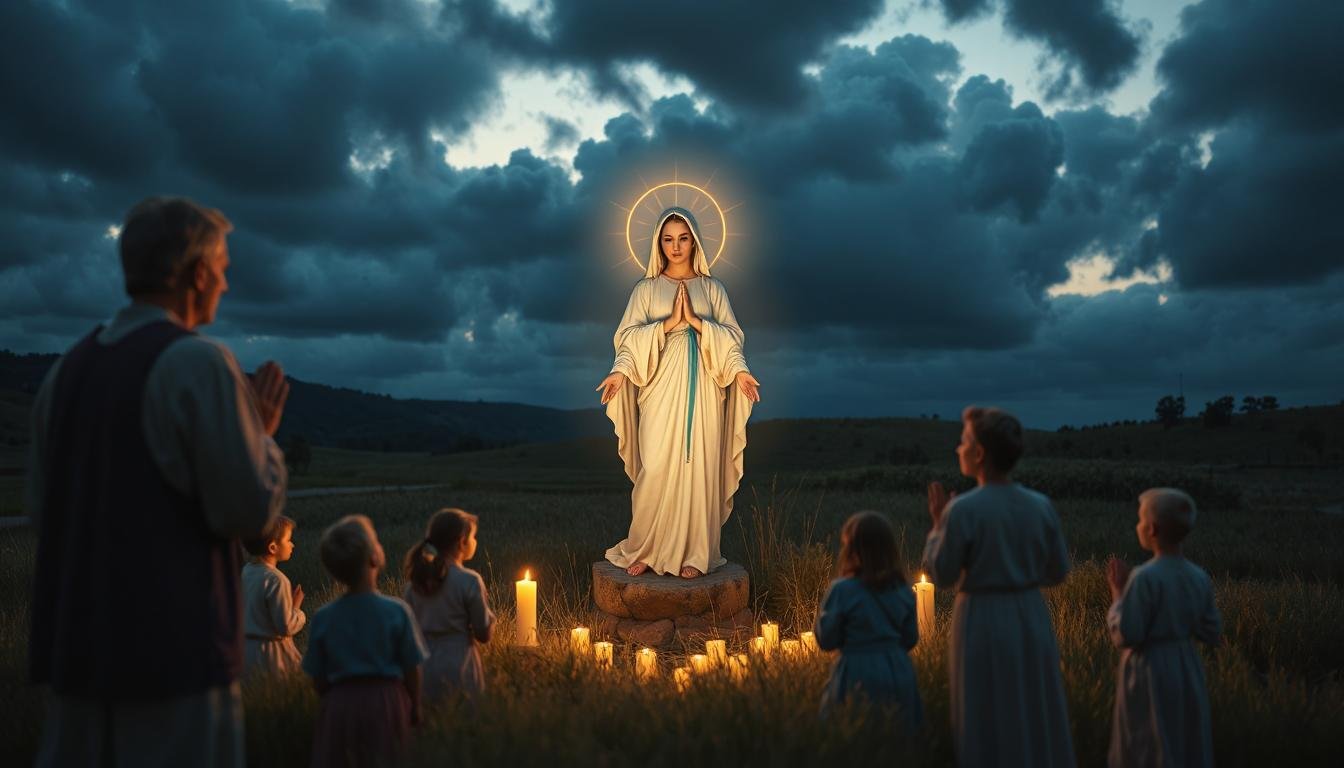
On May 13, 1917, and in subsequent months until October, three children—Lucia dos Santos and her cousins Francisco and Jacinta Marto—reported visions of a woman identifying herself as the Lady of the Rosary. On October 13, an estimated 70,000 people witnessed a “miraculous solar phenomenon” immediately after the apparition. The bishop of Leiria approved the visions on October 13, 1930, granting papal indulgences to pilgrims.
The devotion includes frequent rosary recitation and veneration of the Immaculate Heart of Mary. The first national pilgrimage occurred in 1927; the basilica was begun in 1928 and consecrated in 1953. It features a 65-meter-high tower with a bronze crown and crystal cross, facing the Chapel of the Apparitions. Numerous cures have been reported. On the 50th anniversary of the first vision, May 13, 1967, about one million pilgrims gathered to hear Pope Paul VI celebrate mass. Populations were 7,756 (2001) and 7,710 (2011 est.).
At the end of the 20th century, speculation arose about the three messages reportedly given to the children. Two messages had been revealed in the 1940s—interpreted as predicting the end of World War I, the start of World War II, and the rise and fall of communism. The third, kept secret by the Vatican, was revealed in May 2000 as referring to the 1981 assassination attempt on Pope John Paul II, announced during the beatification ceremony for Francisco and Jacinta Marto.
Eucharistic Miracles
A Eucharistic miracle involves the Eucharist, believed by the Catholic Church and other denominations to be the real presence of Christ. These miracles are distinct from divine revelation and private revelation.
Reported phenomena include consecrated Hosts visibly transforming into human heart tissue, being preserved for long periods, surviving fire, bleeding, or sustaining people for decades. The Catholic Church investigates claims thoroughly before declaring them “worthy of belief,” distinguishing real miracles from contamination, such as by bacteria like Neurospora crassa or Serratia marcescens.
Belief in approved Eucharistic miracles is not mandatory, but often reassures believers of God’s presence. The Church differentiates true miracles from natural occurrences. For example, a 2006 host in Dallas turned red but was shown by biologists to be fungal and bacterial in origin. In contrast, the 2008 Sokółka miracle involved human heart tissue, confirmed by electron microscopy and pathomorphological analysis, ruling out bacterial explanations.