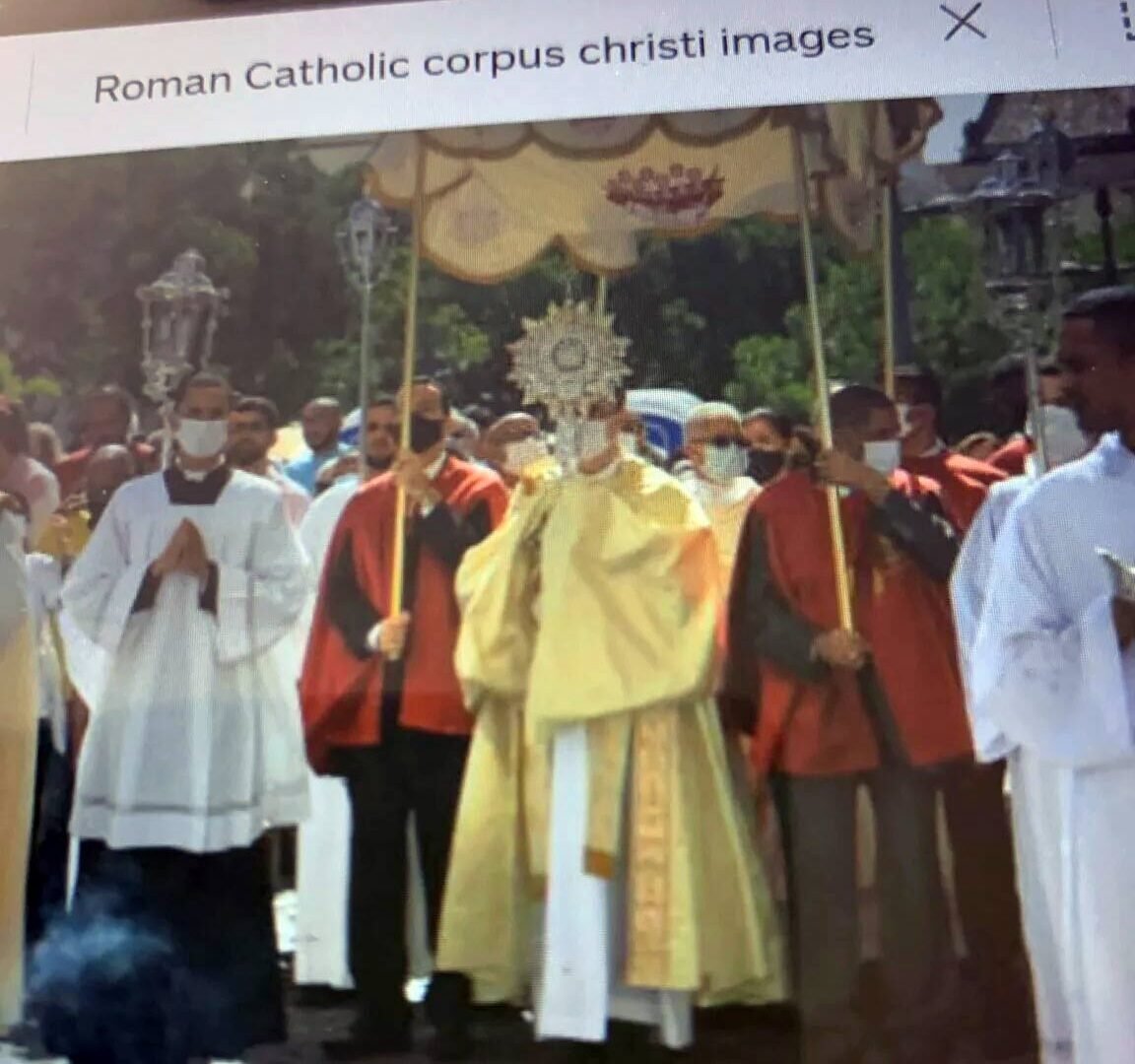
While the institution of the Eucharist is celebrated on Holy (Maundy) Thursday, the liturgy on that day also commemorates Christ’s washing of the disciples’ feet, the institution of the priesthood and the agony in the Garden of Gethsemane. So many other functions took place on this day that the principal event was almost lost sight of. This is mentioned in the Bull Transiturus as the chief reason for the introduction of the new feast. Hence, the feast of Corpus Christi was established to create a feast focused solely on the Holy Eucharist.[11]
Three versions of the office for the feast of Corpus Christi in extant manuscripts provide evidence for the Liège origins and voice of Juliana in an original office, which was followed by two later versions of the office. A highly sophisticated and polished version can be found in BNF 1143, a musical manuscript devoted entirely to the feast, upon which there is wide scholarly agreement: the version in BNF 1143 is a revision of an earlier version found in Prague, Abbey of Strahov MS D.E.I. 7, and represents the work of Thomas Aquinas following or during his residency at Orvieto from 1259 to 1265. The office can also be found in the 1343 codex Regimen Animarum.[22]: 13 This liturgy may be used as a votive Mass of the Blessed Sacrament on weekdays in ordinary time.[23] The hymn Aquinas composed for Vespers of Corpus Christi, Pange Lingua or another eucharistic hymn, is also used on Maundy Thursday during the procession of the Blessed Sacrament to the altar of repose.[24]
The last two verses of Pange Lingua are also used as a separate hymn, Tantum Ergo, which is sung at Benediction of the Blessed Sacrament. O Salutaris Hostia, another hymn sung at Benediction of the Blessed Sacrament, comprises the last two verses of Verbum Supernum Prodiens, Aquinas’ hymn for Lauds of Corpus Christi. Aquinas also composed the propers for the Mass of Corpus Christi, including the sequence Lauda Sion Salvatorem. The epistle reading for the Mass was taken from Paul’s First Epistle to the Corinthians (1 Corinthians 11:23–29), and the Gospel reading was taken from the Gospel of John (John 6:56–59).
