
When Pope Pius V revised the General Roman Calendar (see Tridentine calendar), Corpus Christi was one of only two “feasts of devotion” that he kept, the other being Trinity Sunday.[25] In that calendar, Corpus Christi was celebrated on the Thursday after Trinity Sunday.[26] The feast had an octave until 1955, when Pope Pius XII suppressed all octaves, even in local calendars, except those of Christmas, Easter and Pentecost (see General Roman Calendar of Pope Pius XII).
From 1849 until 1969, a separate Feast of the Most Precious Blood of Our Lord Jesus Christ was assigned originally to the first Sunday in July, later to the first day of the month. This feast was removed from the General Roman Calendar in 1969, “because the Most Precious Blood of Christ the Redeemer is already venerated in the solemnities of the Passion, of Corpus Christi and of the Sacred Heart of Jesus and in the feast of the Exaltation of the Holy Cross. But the Mass of the Most Precious Blood of Our Lord Jesus Christ is placed among the votive Masses”.[27]
Celebration
Western Christianity
Roman Catholic Church

The feast of Corpus Christi is one of five occasions in the year on which a diocesan bishop is not to be away from his diocese unless for a grave and urgent reason.[28]
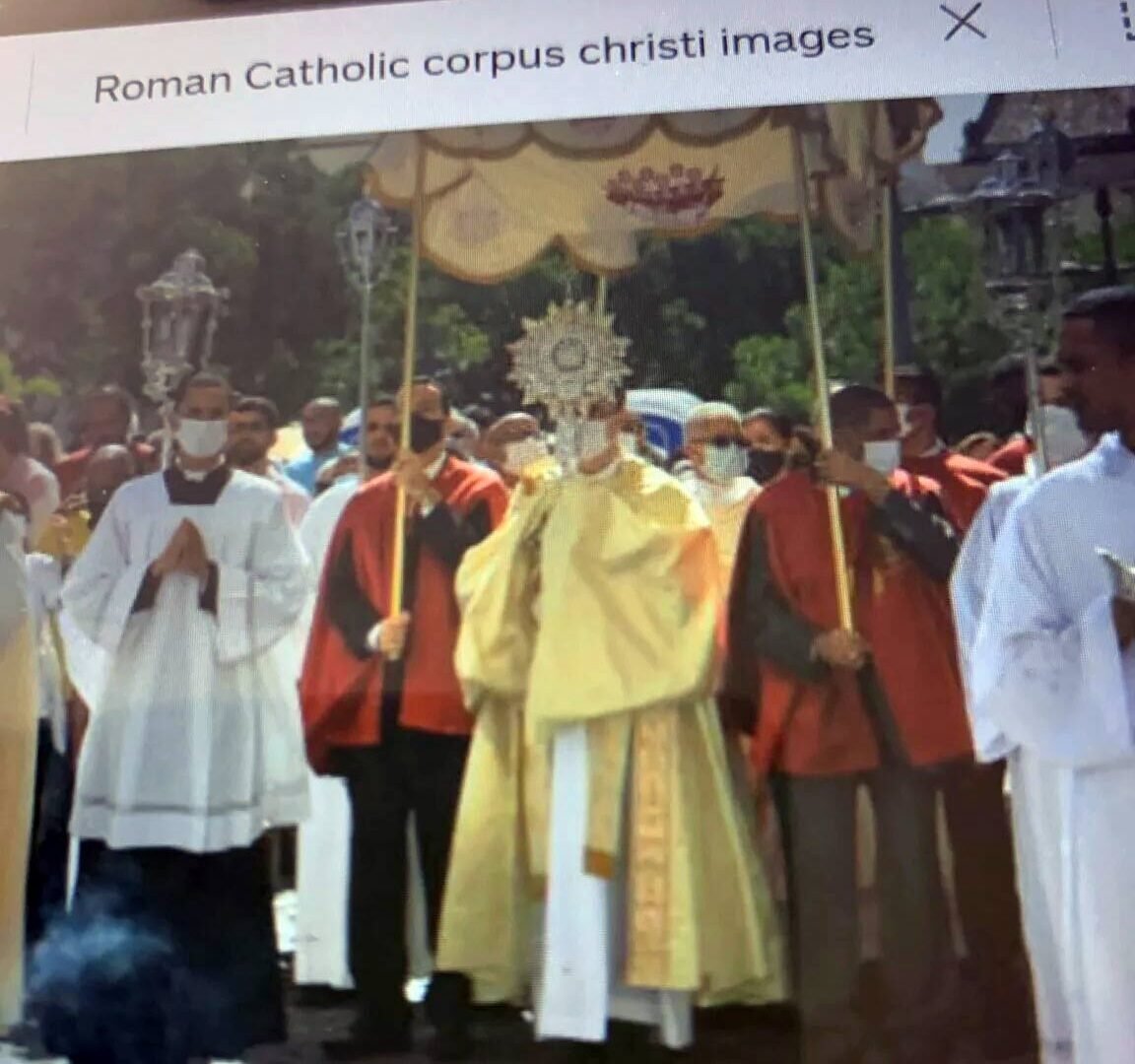
In many countries, the day is a holy day of obligation to participate in the celebration of Mass and takes place on the Thursday after Trinity Sunday. On that day or on the following Sunday, which is the feast day where it is not a holy day of obligation, it is traditional to hold in the streets of a town or in an individual parish a procession with prayers and singing to honor the Blessed Sacrament. During the procession, the consecrated host is displayed in a monstrance held aloft by a member of the clergy. At the end of the procession, Benediction of the Blessed Sacrament is imparted.[29]
_2023-06-11.jpg)
A notable procession in the Philippines is that of the Archdiocese of Manila. The archbishop celebrates a mid-afternoon Mass at the Shrine of the Blessed Sacrament in Santa Cruz before presiding over a procession to the Manila Cathedral.[30]
